
In our first blog, “Inside Symantec CBX: A Unified XDR Platform for Faster Security Investigation,” we introduced the bigger idea behind Symantec CBX: helping security teams see more, stop more, and respond faster.
We talked about the challenges many teams face today. Too many tools. Too many alerts. Too many dashboards. Not enough time to connect everything together.
Now, let’s zoom in on one of the most important parts of that story: endpoint security.
Because in many cyberattacks, the endpoint is where the first clue appears.
- A laptop opens a suspicious file.
- A trusted application behaves in an unusual way.
- A process connects to an unknown destination.
- A user accesses sensitive data.
- A device starts doing something it normally does not do.
Each one of these actions may look small on its own. But together, they can reveal the full attack story.
That is why endpoint security is not just another layer inside CBX. It is one of the foundations that helps the entire platform work smarter.
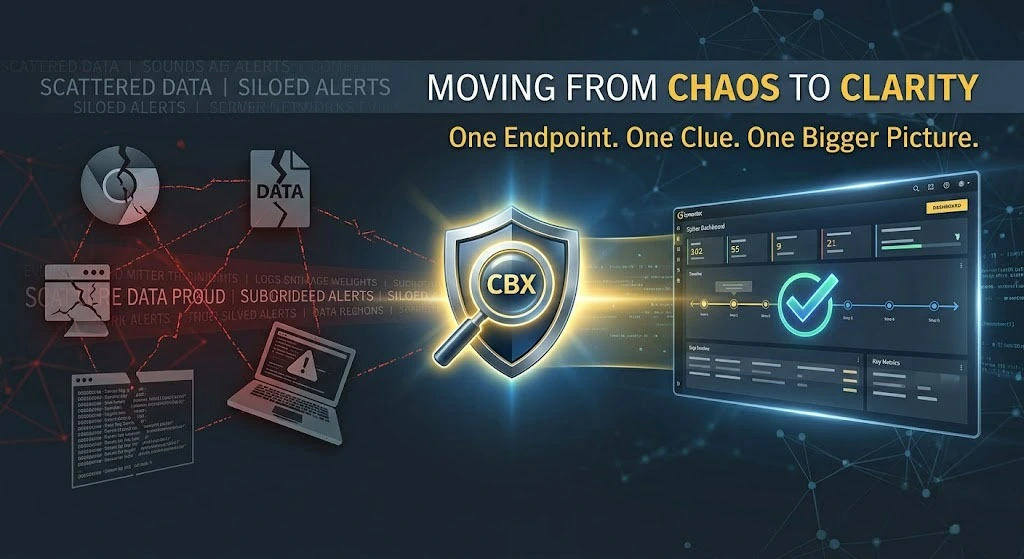
Why the Endpoint Is Still the First Place to Look?
Modern cyberattacks are not always loud or obvious.
Attackers do not always use traditional malware that security tools can easily recognize. Many attacks now rely on legitimate tools that already exist inside the environment. This is often called living off the land.
For example, attackers may use tools like PowerShell, Microsoft Office, scripts, or system utilities to carry out malicious activity. These tools are not automatically bad. In many companies, they are used every day for normal work.
The challenge is understanding when a trusted tool is being used in an untrusted way.
This is where endpoint security becomes critical.
The endpoint can help answer important questions:
- Who started the activity?
- Which device was involved?
- What process was running?
- What file was opened, changed, or moved?
- Was the behavior normal for that environment?
- Did the activity connect to a suspicious web destination?
- Was sensitive data involved?
- When endpoint data is connected with web and data security context, the picture becomes much clearer.
That is the value of CBX.
The Problem: Security Teams Have the Data, But Not Always the Context
Most security teams are not struggling because they have too little data.
They are struggling because the data is scattered.
One tool shows endpoint alerts. Another tool shows web activity. Another tool shows data security events. Another tool stores logs. Another system is used for investigation and reporting.
For large teams, this creates complexity. For small and mid-sized teams, it can become overwhelming.
A security analyst may spend more time switching between tools than actually investigating the threat. And when alerts are disconnected, it becomes harder to know what really matters.
- Is this alert serious?
- Is it connected to another event?
- Is this one user issue, or part of a wider attack?
- Was sensitive data touched?
- What should be fixed first?
CBX is designed to make those answers easier to find.
The CBX Difference: One Agent, One Console, One Source of Truth
Symantec CBX brings endpoint protection, endpoint detection and response, web security, and data security enrichment into a more unified experience.
Instead of forcing teams to manage several separate agents and consoles, CBX is built around a simpler model:
One agent.
One console.
One source of truth.
This matters because security tools should not make the analyst’s job harder.
With one agent, teams can reduce endpoint complexity and simplify management.
With one console, teams can view alerts, events, investigations, device information, policies, and remediation actions in one place.
With one source of truth, analysts can understand the full security story without constantly jumping between disconnected tools.
For small and mid-sized teams, this is especially important. Not every organization has a large SOC or dedicated specialists for every product. Many teams need powerful protection, but they also need it to be practical and easy to operate.
CBX supports that need by bringing enterprise-grade security into a more simplified platform experience.
How CBX Turns Endpoint Activity Into a Complete Investigation
Endpoint security becomes much more powerful when it is not isolated.
In CBX, endpoint activity can be connected with web and data security signals to create a more complete investigation.
Instead of looking at one alert at a time, analysts can understand how different activities are related.
CBX organizes security information into three main areas:
Alerts : Alerts show potentially suspicious or malicious activity.
Events: Events provide deeper telemetry and context across endpoint, web, and data security sources.
Investigations:
Investigations combine related alerts and events into one connected view.
This is where CBX helps reduce noise.
Rather than asking an analyst to manually review dozens or hundreds of separate alerts, CBX can group related activity into an investigation. This allows the team to focus on the bigger picture instead of getting lost in individual signals.
The result is a faster, clearer path from detection to response.
Prevention: Stopping Threats Before They Grow
A strong security platform should not only detect attacks. It should help stop them early.
CBX includes endpoint protection capabilities that help teams reduce risk before suspicious activity becomes a larger incident.
These include:
- Central prevention policies that help protect against known and suspicious activity.
- Behavioral protection that looks at what applications and processes are doing, not only whether a file is known to be bad.
- Adaptive Protection that learns what is normal in an environment and helps block risky behaviors that are not usually needed.
- Hash allow and block controls that give teams more control over what can run.
- Custom behavioral policies that allow organizations to define what should be allowed, blocked, or logged.
- Device control to manage external devices such as USB devices, Bluetooth devices, microphones, keyboards, and other connected hardware.
- Endpoint firewall and intrusion prevention to help block risky network behavior and network-based attacks.
- Device posture checks to help enforce security and compliance standards across endpoints.
Together, these capabilities help teams move from basic endpoint protection to smarter, behavior-aware prevention.
Detection: Finding the Signals That Matter
Even with strong prevention, teams still need to detect suspicious behavior quickly.
CBX detection and response capabilities help analysts identify activity that may be part of a larger attack. Instead of showing endpoint activity in isolation, CBX gives analysts additional context across the environment.
This is important because one alert may not tell the full story.
- A process running on one device may look normal.
- A network connection may look harmless.
- A file movement may seem routine.
But when these signals are connected, they may reveal something more serious.
CBX helps analysts understand those connections faster.
Investigation: From Alert Fatigue to Attack Story
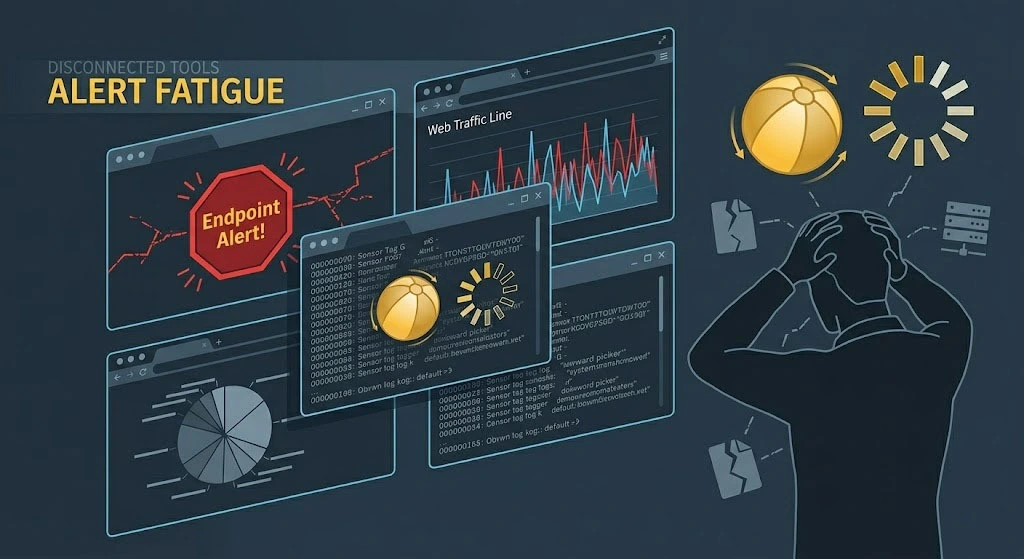
Alert fatigue is one of the biggest problems in cybersecurity.
When analysts receive too many alerts, it becomes harder to know which ones deserve immediate attention. Over time, teams may start ignoring alerts, delaying triage, or focusing only on the most obvious issues.
CBX helps reduce that burden by turning related alerts and events into investigations.
An investigation gives the analyst a clearer view of what happened, who was involved, which devices were affected, what files or processes were part of the activity, and what actions may need to happen next.
This changes the analyst experience.
Instead of asking, “Which alert should I open next?”
The analyst can ask, “What is the full attack story, and how do we respond?”
AI Assistance: Helping Analysts Understand Faster
CBX also uses AI to support investigation workflows.
AI-generated summaries can help explain what happened inside an investigation, including the attack chain, impacted entities, and suggested remediation steps.
This is useful for different types of teams.
- For junior analysts, it can make complex attack activity easier to understand.
- For experienced analysts, it can speed up validation and reduce manual investigation time.
- For small teams, it can help reduce the pressure of having to connect every clue manually.
The purpose is not to replace the analyst. The purpose is to help the analyst move faster with better context.
Threat Tracer: Seeing the Attack Chain Visually
Some attacks are difficult to understand through text and logs alone.
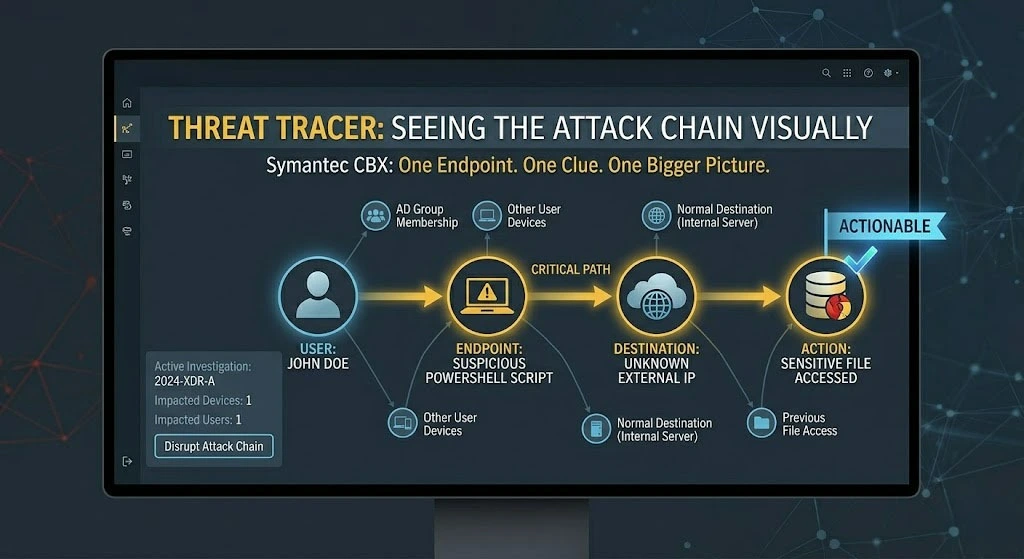
That is why CBX includes Threat Tracer, a visual tool that helps analysts see how different parts of an investigation are connected.
Threat Tracer can show relationships between:
- Devices
- Users
- Processes
- Files
- Domains
- Network activity
- Security events
This gives analysts a visual path through the attack.
Instead of reading through disconnected logs, they can see how one action led to another. This makes it easier to understand the flow of the attack, identify what matters, and decide what to do next.
For teams that need to move quickly, this visual context can make a major difference.
Response: Acting Quickly and Confidently
Understanding an attack is important. But response is where the real impact happens.
CBX helps teams move from investigation to action by providing remediation options inside the same platform experience.
Depending on the situation, teams may be able to take actions such as blocking a hash, quarantining a file, investigating a device, submitting a file to sandbox analysis, or applying policy changes.
CBX also supports attack chain disruption, helping analysts respond earlier by identifying likely next steps in an attack and giving them ways to block risky behaviors.
This matters because the earlier a team can disrupt an attack, the better.
Stopping an attack at an early stage can prevent wider compromise, data exposure, and operational disruption.
Why This Matters for Small and Mid-Sized Teams
Cybersecurity pressure is not limited to large enterprises.
Small and mid-sized organizations are also targeted, but they often have fewer people, fewer tools, and less time to manage complex security operations.
In many organizations, the same team may be responsible for IT support, endpoint management, security monitoring, incident response, and compliance.
That is why simplicity matters.
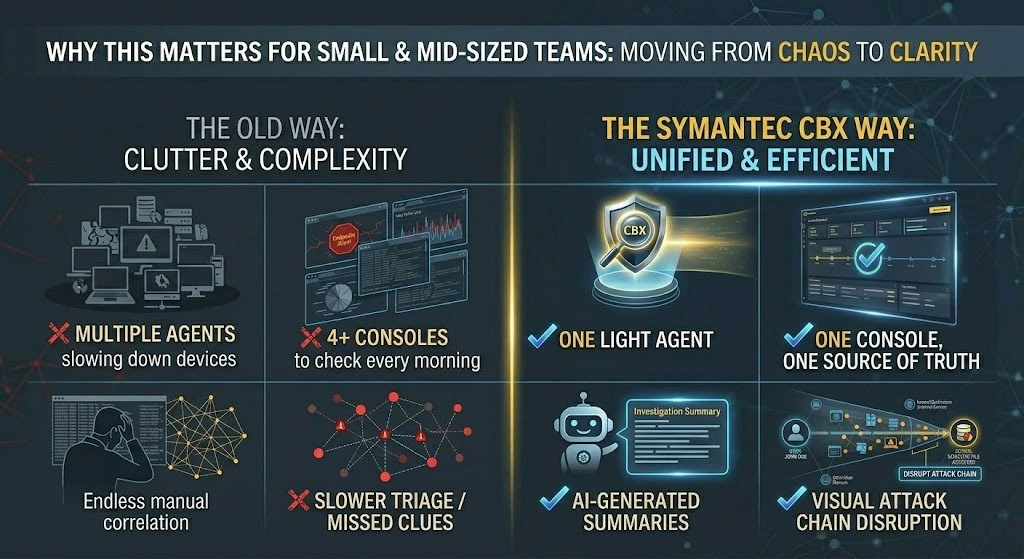
CBX helps small and mid-sized teams by reducing the need to manage many disconnected tools. It gives them a more unified way to protect endpoints, understand alerts, investigate threats, and respond faster.
Instead of needing deep expertise across several separate products, teams can work from a single platform that brings the context together for them.
This is where CBX becomes more than a security product. It becomes an operational advantage.
Why This Matters for Larger Security Teams Too
Large organizations also benefit from this unified approach.
Even when they have dedicated SOC teams, they still face alert fatigue, tool sprawl, and investigation delays. Analysts may still need to pivot between endpoint tools, web security tools, data security systems, SIEM platforms, and ticketing workflows.
CBX helps reduce that friction by connecting important security signals earlier in the investigation process.
This can help larger teams improve efficiency, reduce manual work, and make investigations easier to scale.
Endpoint Security Is No Longer Just About the Device
Traditional endpoint security focused mainly on protecting the device.
Modern endpoint security must do more.
It must help answer:
- What happened?
- How did it start?
- What else was involved?
- Was sensitive data touched?
- Did the activity move across the network?
- What is the attacker likely to do next?
- How can the team stop it quickly?
CBX helps answer these questions by connecting endpoint security with broader platform context.
That is why endpoint security is not just one part of CBX. It is one of the starting points for the entire investigation and response workflow.
Conclusion: From Endpoint Alerts to Unified Security Action
In our first blog, we introduced Symantec CBX as a unified XDR platform built to help teams gain more context and respond faster.
Endpoint security is where that unified story becomes practical.
The endpoint provides critical signals. CBX connects those signals with web and data security context. Then it uses correlation, AI, investigations, and visual attack mapping to help teams understand and act.
For small and mid-sized teams, this means enterprise-grade security with less complexity.
For larger organizations, it means faster investigations and stronger correlation across security layers.
For every team, it means moving away from scattered alerts and toward a clearer security story.
With Symantec CBX, endpoint security is not just about protecting devices.
It is about helping the entire security team see the full picture, stop threats earlier, and respond with confidence.
Egirna Technologies is ready to help with expert professional services that support deployment, optimization, and long-term success, enabling your team to get the most value from its security investments. Contact Egirna Technologies today to discover how we can help you build a faster, stronger, and more resilient security operation.
Egirna Technologies is ready to help with expert professional services that support deployment, optimization, and long-term success, enabling your team to get the most value from its security investments. Contact Egirna Technologies today to discover how we can help you build a faster, stronger, and more resilient security operation.