
One Platform, More Context: Inside Symantec CBX
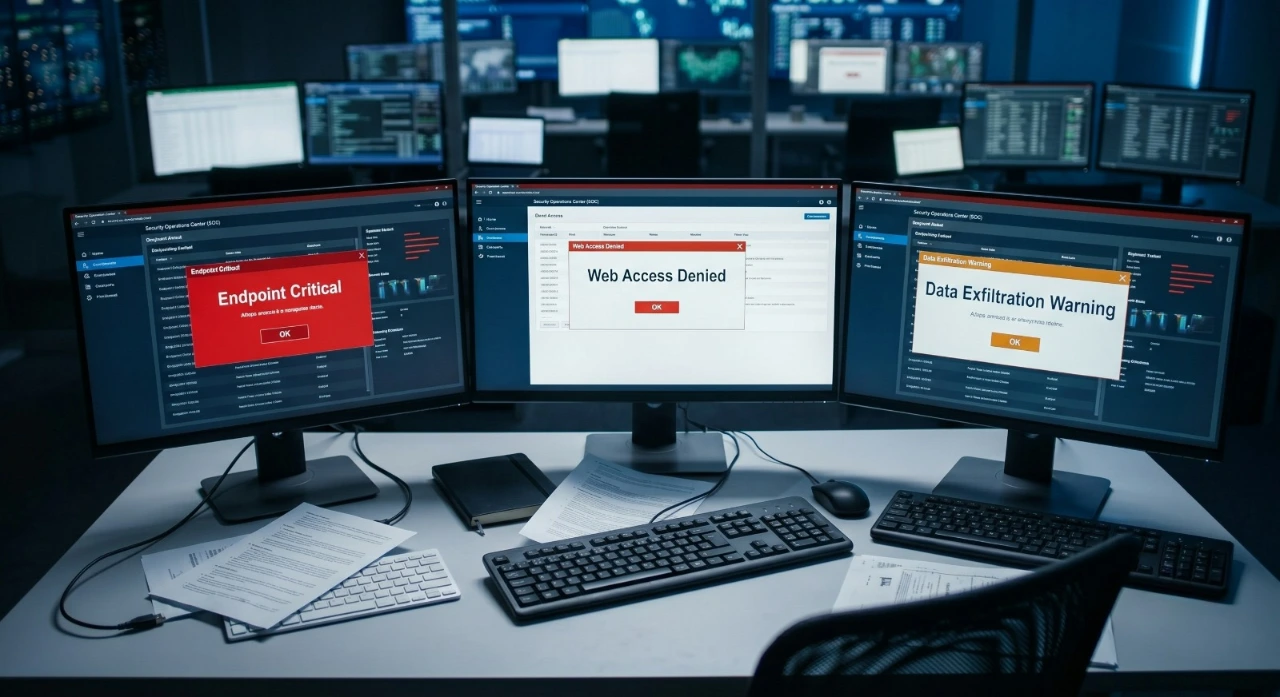
Imagine starting the day in a busy Security Operations Center. Within minutes, alerts begin piling up. One console shows endpoint activity. Another displays suspicious web events. A third flag for possible data movement. Somewhere else, network logs and spreadsheets are waiting to be reviewed.
The challenge is not a lack of information. The fact is that the information is spread across too many places.
That is the reality many security teams face today. Over time, organizations have added more cybersecurity tools to address specific risks. But as those tools multiply, investigations often become more fragmented. Analysts are left piecing together signals manually while attackers move across endpoints, users, networks, cloud services, and sensitive data.
To respond effectively, teams need more than visibility into separate tools. They need the full picture.
Symantec CBX, or Carbon Black XDR, is designed to provide that picture. By bringing together Symantec and Carbon Black technologies in a single cloud-based platform, Symantec CBX helps security teams investigate faster, reduce alert fatigue, and respond with greater confidence.
How Symantec CBX Brings Security Signals Together
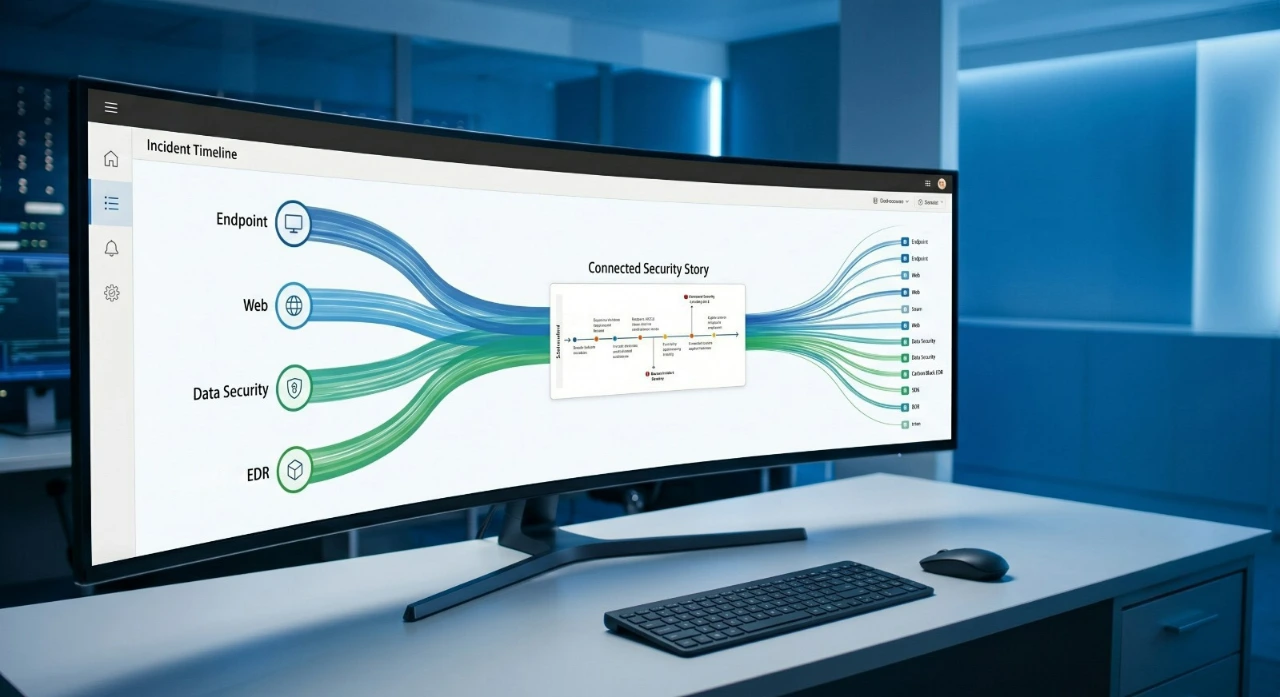
Symantec CBX is Broadcom’s Extended Detection and Response (XDR) platform, combining endpoint, EDR, web, and data security telemetry into a single security experience.
In practical terms, it helps teams understand how separate events are related.
Instead of reviewing endpoint activity in one place, web activity in another, and data security alerts somewhere else, analysts can investigate from a single platform that correlates these signals. This makes it easier to understand what is happening across the environment and to see the sequence behind an incident.
For technical teams, that means stronger detection, investigation, analytics, and response across multiple domains. For business and IT leaders, it means less time spent sorting through disconnected alerts and more time focused on actual risk.
The Problem with Fragmented Security Tools
Layered security is necessary. Most organizations rely on a mix of endpoint protection, EDR, web security, data protection, firewall capabilities, intrusion prevention, analytics, and response tools.
The problem is that these layers often operate independently.
For analysts, this can mean switching between consoles, using different query languages, comparing unrelated alerts, and manually reconstructing attack timelines. For IT and security leaders, it often means the team is overwhelmed by alerts without enough context to decide what matters most.
This creates three common challenges:
- Alert fatigue as teams receive more alerts than they can realistically investigate.
- Blind spots, when important relationships between events go unnoticed.
- Slower response, as valuable time is spent gathering context instead of containing threats.
Attackers are quick to exploit these gaps. Many rely on legitimate tools such as PowerShell, Microsoft Office, or administrative utilities to blend into normal activity. This tactic, often called “living off the land,” is especially hard to detect when teams cannot see the surrounding context.
The real question is no longer whether a file or tool is inherently good or bad.
The real question is whether the behavior makes sense in context.
What Symantec CBX Looks Like in Practice
Imagine an analyst investigating what first appears to be a routine endpoint alert. On its own, the alert may not seem urgent. But when that activity is correlated with unusual web behavior and a suspicious attempt to move sensitive data, the situation looks very different.
Instead of treating these as separate low-priority events, Symantec CBX helps bring them together into a single investigation. That allows the analyst to understand the broader pattern faster, prioritize the threat appropriately, and respond before the activity escalates.
This kind of connected investigation is where XDR becomes especially valuable.
Key Features of Symantec CBX
Symantec CBX is built to help teams move from isolated alerts to more complete investigations. Several capabilities support that goal.
Unified Data Stream
At the core of Symantec CBX is the Unified Data Stream (UDS), which helps normalize security events across endpoint, web, and data security layers. By making those signals easier to correlate, UDS turns disconnected activity into a clearer investigative path.
One Platform, One Agent
Symantec CBX uses a single-platform experience and a single-agent approach built on the Symantec Endpoint Security Agent platform. This helps reduce endpoint complexity, minimize agent conflicts, and limit the need for risky exclusions that can create security gaps.
For smaller teams, this can simplify management. For larger organizations, it can improve operational efficiency across a broader range of operations.
Threat Tracer Visualization
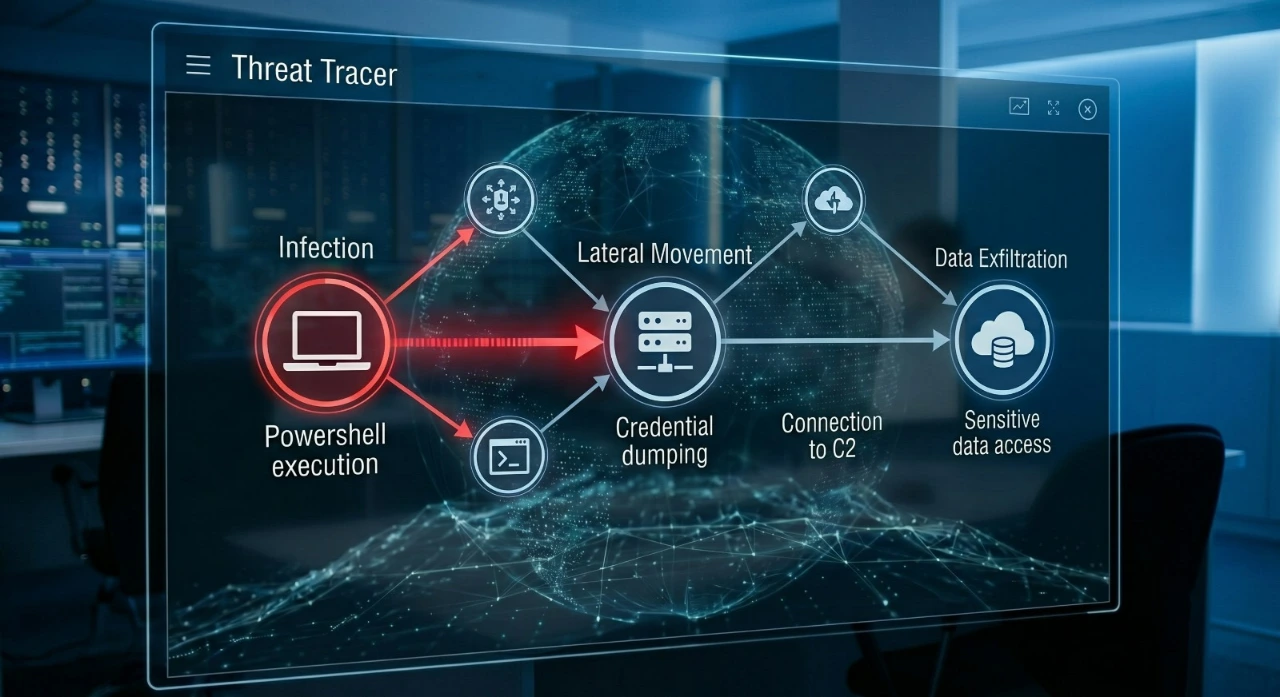
Threat Tracer helps analysts see the relationships between processes, files, users, and network connections. Rather than combing through logs line by line, they can follow the flow of an attack more intuitively and understand how activities are connected.
AI-Generated Attack Summaries
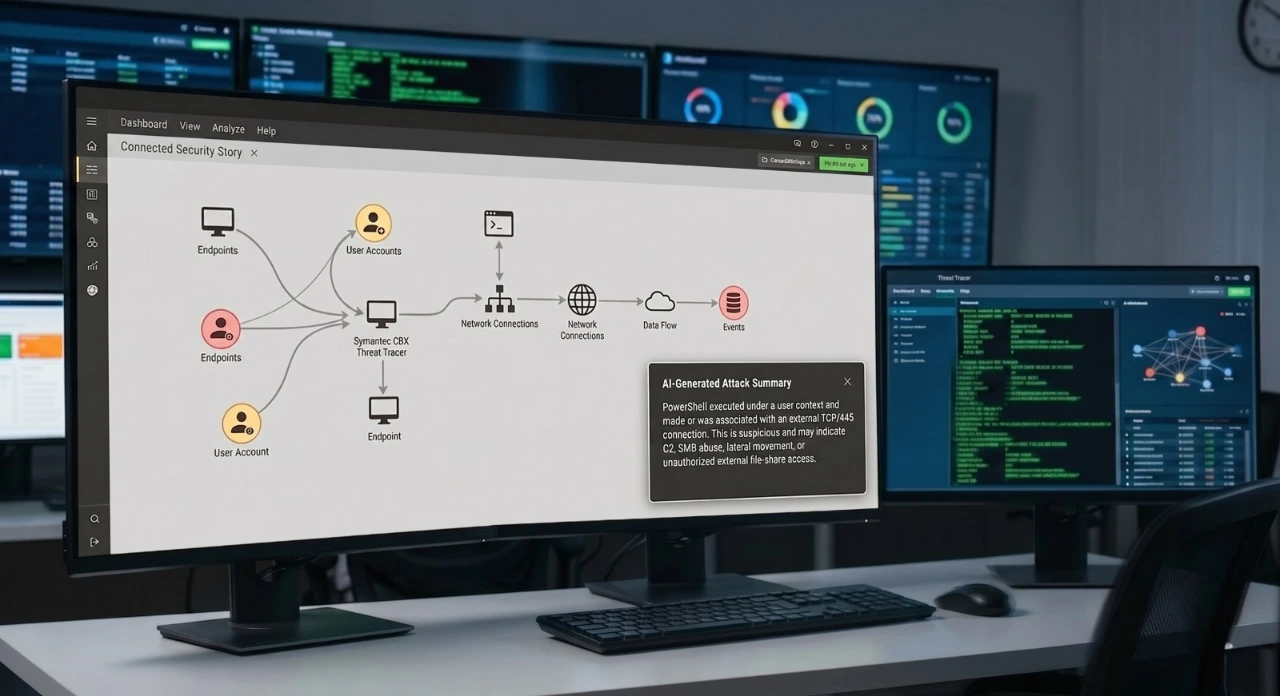
Symantec CBX uses AI-generated summaries to explain attack chains in clear, human-readable language. This can help junior analysts ramp faster and give senior analysts a quicker way to validate findings.
It also makes incidents easier to communicate to non-technical stakeholders by translating technical details into a more accessible narrative.
Targeted Attack Analytics
Using machine learning and targeted attack analytics, Symantec CBX can stitch related events into a single investigation. Instead of forcing teams to sort through large volumes of disconnected alerts, it helps surface the activity that deserves attention first.
Adaptive Protection and Incident Prediction
Symantec CBX also supports a more proactive approach. Through Adaptive Protection, it learns what normal endpoint activity looks like over time within a specific environment. Incident prediction helps teams anticipate the likely next steps based on known attack patterns.
Why It Matters for Security Teams
Security teams do not need more dashboards. They need faster answers.
Symantec CBX is designed to help teams investigate with more confidence by improving context, reducing manual correlation, and simplifying operations.
For enterprise teams, that can mean better visibility across complex environments and quicker investigations. For smaller and mid-size teams, it can mean less time spent managing multiple tools and more time focused on the incidents that matter.
The value is not just in collecting more signals. It is in helping teams:
- Triage faster.
- Reduce false leads.
- Investigate with fewer tool switches.
- Improve communication across technical and non-technical stakeholders.
- Move from reactive response toward a more proactive defense.
Final Thoughts
In today’s threat landscape, attackers move quickly and quietly. Keeping up requires more than a collection of separate tools.
Security teams need a clearer view of how activity connects across the environment. They need context to distinguish noise from meaningful risk. And they need a platform that supports faster, more informed decisions.
Symantec CBX is built to help deliver that clarity.
If your team is looking to simplify investigations, reduce noise, and respond with more confidence, Symantec CBX offers a more connected approach to modern threat detection and response.
Egirna Technologies is ready to help with expert professional services that support deployment, optimization, and long-term success, enabling your team to get the most value from its security investments. Contact Egirna Technologies today to discover how we can help you build a faster, stronger, and more resilient security operation.